
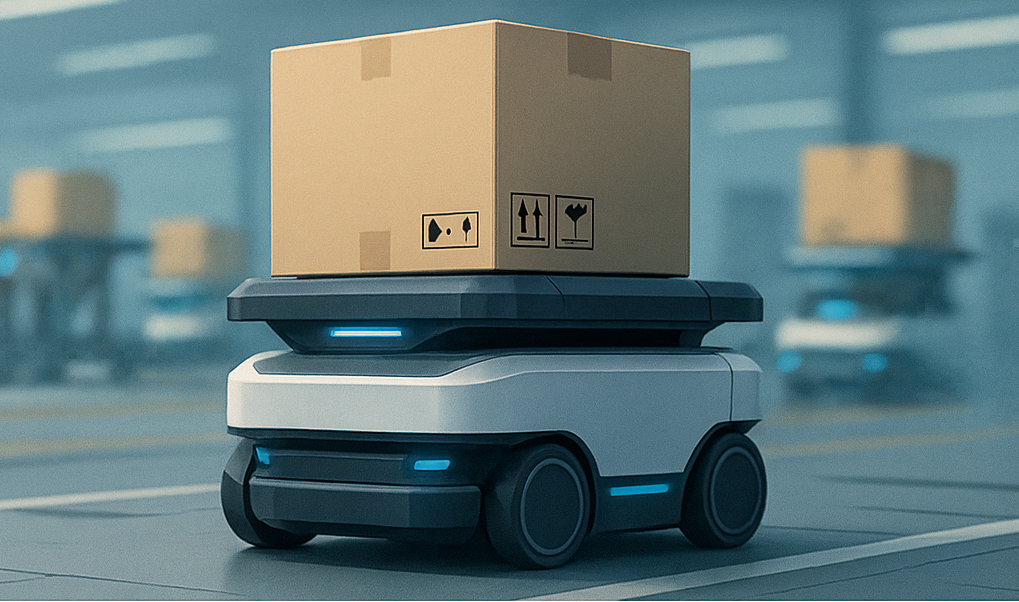
This is the second post in our AI & Robotics Trends series. After examining the use of AI-controlled drones in our first blog, today we turn to another key technology of industrial automation: autonomous mobile robots (AMR). They are transforming the way goods are moved, orders are picked, and production lines are supplied – more quietly, safely, and precisely than ever before.
The global AMR market is currently estimated at around USD 2.8 billion and is expected to grow to over USD 13 billion by 2034, representing an annual growth rate of more than 17 percent. Studies show that companies can increase efficiency by up to 30 percent through the use of such systems while significantly reducing manual labor.
Before diving deeper, let’s briefly explain the key terms – so you can easily follow the concepts in this article. Autonomous Mobile Robots (AMR) are self-driving vehicles that use sensors, cameras, and artificial intelligence to navigate independently, detect obstacles, and adjust their route in real time. Unlike traditional Automated Guided Vehicles (AGV), they do not require fixed tracks, making them more flexible and scalable. OMRON is a leading Japanese manufacturer of automation technologies and is considered a global driver of modern robotics. Its AMR solutions are used in various industries – from manufacturing to logistics. LiDAR – laser sensors for precise environmental and obstacle detection. SLAM (Simultaneous Localization and Mapping) – a method that allows robots to map their surroundings while determining their own position. Intralogistics – covers all material and goods flows within a company.
Autonomous mobile robots are among the most exciting developments in modern industry. They move independently through factories and warehouses, transport materials, supply production lines, and take over tasks that previously required considerable time and effort. This is no longer limited to large corporations – smaller companies are also discovering how this technology simplifies operations and boosts productivity.
To operate with such precision and safety, AMRs rely on advanced technologies – especially LiDAR and SLAM. LiDAR works similarly to radar but with light beams: the robot emits laser pulses, measures how long the light takes to bounce back from walls, pallets, or people, and creates an exact 3D image of its surroundings. SLAM ensures that this map is continuously updated so the robot always knows its exact position. This allows it to avoid obstacles, plan routes autonomously, and safely navigate even through narrow spaces.
In a typical factory, AMRs appear as flat, mobile platforms. They move precisely and predictively through the hall, stop when people or obstacles appear, and resume once the path is clear. They are coordinated via a central platform so that multiple robots can move simultaneously without interference. Their tasks range from transporting individual components to automatically supplying entire production lines.
What makes them special is their adaptability: unlike traditional conveyor belts or transport systems that are permanently installed, AMRs respond flexibly to environmental changes. They can quickly plan new routes, take detours, or take on additional tasks spontaneously. For companies, this means less downtime, lower costs, and significantly safer operations.
Beyond efficiency, AMRs also improve sustainability. They move only when needed, always choose the shortest route, and thus consume less energy. This not only reduces CO₂ emissions but also extends device lifespan and lowers maintenance costs.
Practical Examples:
Below are three concrete examples from different industries that illustrate how AMRs are already being successfully deployed today.
Material Flow Automation in Production:

A global industrial company fully automated its internal material transport using OMRON AMRs. The robots now handle the entire flow between manufacturing and assembly areas. The result: 30 percent faster production line supply, fewer errors, and better space utilization. This example shows how AMR systems can be integrated into existing production environments without disrupting ongoing operations.
Knowledge, Links & Sources:
Optimization of Internal Transport with AMR:

A European lighting company implemented AMRs to automate the internal transport of roll cages. Employees were relieved from repetitive tasks, while material flow efficiency increased by 30 percent. The robots safely navigate narrow aisles, automatically detect people and obstacles, and communicate with elevator and door systems. This scenario demonstrates that even medium-sized companies can gain a clear, measurable competitive advantage through AMR.
Knowledge, Links & Sources:
AMR in E-Commerce and Fulfillment:

In e-commerce, companies like Brightpick are revolutionizing warehouse operations. Their intelligent AMRs use AI, 3D vision, and SLAM navigation to autonomously pick orders and manage inventory. Early adopters report significantly lower labor costs and higher order accuracy. This demonstrates that mobile robotics is not just for large enterprises – smaller distribution centers also benefit from modular, scalable systems.
Knowledge, Links & Sources:
How We Can Support You
With over 30 years of experience in large-scale Swiss projects, ITConsulting24 AG supports companies in analyzing and strategically planning AI-driven automation solutions. We help you understand the technological possibilities, find the right partners, and make well-informed investment decisions.
Outlook & Feedback
The AMR market is developing rapidly and will soon become standard in European production and logistics centers. Swiss companies are also beginning to launch pilot projects to counteract skills shortages and cost pressures. In the next blog of our series, we will focus on humanoid robots in customer service – and how AI gives these systems a human face.