
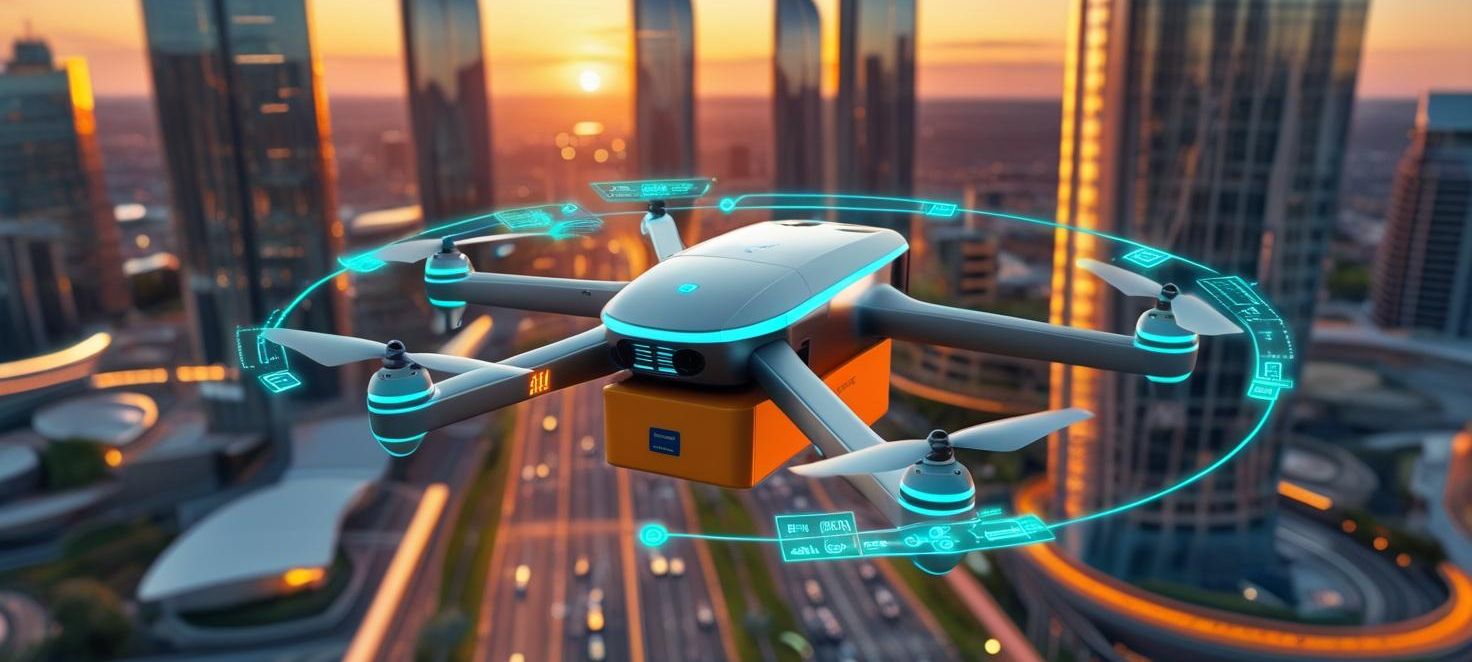
The global industry for parcel deliveries by drone is currently estimated at around five billion US dollars and is expected to grow to over 33 billion USD by 2030 – with an annual growth rate of just under 37 percent. Locally operated autonomous drones can shorten delivery times by more than 50 percent, at the same time reduce delivery costs per location by a mid five-figure amount, and produce noticeable relief in the traffic network. Electric drives and short flight distances reduce CO2 emissions by up to 70 percent compared to conventional vehicles.
Decision-makers in modern companies are facing a true disruption: the introduction of AI-powered drones as a strategic logistics instrument is no longer a future scenario, but a real opportunity to increase operational efficiency, lower environmental impacts, and secure a market advantage.
In Switzerland, drones are still not widely used, primarily due to regulatory hurdles. Swiss legislation requires a permanent visual line of sight between pilot and drone, which severely restricts operations. Nevertheless, the market is moving here as well – particularly through initiatives to relax regulations and through strong interest from companies and industry associations. There is enormous potential especially for Swiss companies once these regulatory frameworks are adjusted. Decision-makers should monitor this development closely and make strategic preparations at an early stage.
Manna Aero – Pioneer from Dublin

Manna Aero is an Irish startup specializing in autonomous deliveries by drone that has attracted significant international attention. The company is considered an “Amazon challenger” in the industry and aims to revolutionize the last mile of logistics in a sustainable and efficient way. By April 2025, Manna Aero had already carried out over 200’000 autonomous delivery flights – up to 80 missions per drone are completed daily, with average delivery times of about 16 minutes. This means a doubling of speed compared to traditional bicycle courier systems.
Knowledge, Links & Sources:
Zipline – Scaling for Healthcare and Retail

Zipline, founded in the USA, has become a global leader in autonomous drone deliveries and is particularly known for medical deliveries to remote regions of Africa. The company now has a significant presence in the U.S. market and works with major partners such as Walmart. By March 2025, Zipline had completed more than 1.4 million autonomous delivery flights and achieved an impressive 100 million kilometers in autonomous operation. In March 2025, Zipline also received official authorization for nationwide operations across all 50 U.S. states. Its drones supply medical facilities and retailers with delivery times of under 30 minutes and are setting new standards in speed and sustainability.
Knowledge, Links & Sources:
Phoenix Air Unmanned & Shell – Industrial Inspection

Phoenix Air Unmanned is a leading U.S. provider of specialized drone services for industrial inspections. The company works closely with global energy firms, including Shell, one of the world’s largest oil and gas companies. In January 2025, Phoenix Air Unmanned conducted an impressive pipeline inspection for Shell over a distance of 320 miles (515 km) in just 7.6 hours. This operation significantly reduced personnel effort, increased safety standards, and considerably lowered inspection costs.
Knowledge, Links & Sources:
How it works at a glance
AI-powered drones combine high-resolution cameras, LiDAR scanners, GPS and RTK positioning, and integrated AI systems. Obstacle avoidance, autonomous landing, and data capture are performed automatically. Edge processing reduces latency, while BVLOS approvals enable long ranges. Central fleet control guarantees scalable deployments.
Benefits for environment and infrastructure
Drones significantly reduce CO2 emissions. Less road traffic leads to fewer traffic jams, reduced noise pollution, and lower infrastructure wear. In addition, the use of drones reduces the need for storage space and vehicles.
Clarifying the terms
Autonomous drones are unmanned aircraft with artificial intelligence that, thanks to real-time control, can take off, navigate, avoid obstacles, and land independently – without constant human intervention. Edge computing enables data processing directly on board, so decisions can be made immediately. BVLOS capability (Beyond Visual Line of Sight) allows operation outside the line of sight. So-called swarm intelligence enables coordinated deployments of multiple drones for complex tasks.
How we can support you
ITConsulting24 AG supports you with 30 years of experience from renowned Swiss large-scale projects, specifically in analyzing innovation potential, building knowledge, and strategically integrating AI technologies. Our expertise creates decisive added value in demanding technical undertakings and AI-driven innovation projects.
Outlook & feedback
By 2026, intelligent drones are likely to be taken for granted in many industries. We look forward to your feedback: Which fields of application interest you the most? Which challenges do you see? Your input helps us shape future articles.