
Autonomous systems today often appear more intelligent than their actual technical implementation would suggest. Many machines can see, hear, or sense their surroundings, yet they do not make decisions where those signals are generated. Instead, data is typically processed in a central environment, often in the cloud, and the resulting decision is sent back to the system. This approach works only as long as time, connectivity, and energy are not limiting factors. Those assumptions break down precisely in situations where machines are expected to act independently, reliably, and continuously. Edge AI chips mark a fundamental architectural shift at this point, one that becomes central to robotics and physical systems from 2026 onwards.
The economic backdrop of this development can be summarised succinctly. The market for edge AI chips is growing from a few billion US dollars in the mid-2020s to well over ten billion dollars in the early 2030s. This growth is driven less by fashion than by technical necessity. Anyone bringing artificial intelligence into physical processes must move decision-making closer to where reality unfolds.
Before going deeper into the subject, a short section follows that explains the key terms and abbreviations relevant to understanding this article.
When specialised AI hardware is discussed in the context of edge AI chips, several terms appear that are often used inconsistently. One central concept is inference, meaning the execution of an already trained AI model during operation. Unlike training, which is computationally intensive and typically performed in centralised training infrastructures, inference describes the moment when sensor data is evaluated and translated into a decision. This phase determines how quickly and reliably a system can respond.
To execute inference efficiently, specialised compute units are used. The term TPU is common, short for Tensor Processing Unit. These are hardware units designed to process large volumes of similar mathematical operations, as found in AI models. NPU, or Neural Processing Unit, follows a similar principle and is specifically designed for executing neural models. Neither TPU nor NPU represents a fixed standard; both describe classes of processing units with a shared objective: maximising efficiency for AI workloads while minimising energy consumption. It is worth noting that GPUs can be used for both training and inference, while TPUs and especially NPUs are, depending on their design, primarily optimised for inference. What matters most is not the processor class itself, but where execution takes place within the overall system architecture.
Another important aspect is system determinism. In technical terms, a deterministic system produces the same response times and outcomes given the same inputs under the same conditions. In centralised AI architectures, this property is undermined by network dependencies and fluctuating load. Local inference on edge AI chips improves determinism because the decision path is clearly defined and temporally stable.
Finally, the notion of the edge plays an architectural role. It does not describe a physical location, but a layer in system design. The edge is where digital processing directly interfaces with the physical world, where sensors capture signals and actuators execute actions. Placing AI at the edge means bringing decision logic as close as possible to real processes, rather than delaying it across multiple system layers.
With these concepts in mind, the limits of classical AI architectures become apparent. Many devices in use today rely on universal processors, the same types long used in industrial computers, controllers, and embedded systems. These CPUs are flexible but not designed to execute AI models efficiently. When AI is nevertheless applied, evaluation typically takes place outside the device. Sensor data is transmitted over the network to a central processing environment, usually cloud-based and equipped with specialised AI hardware. The decision is then returned to the device. The system executes instructions, but it does not decide.
This approach is rooted in the historical development of computing architectures. Classical CPUs are optimised to execute a wide range of tasks sequentially. They are well suited to control logic, coordination, and communication, but they struggle when large volumes of identical operations must be processed in parallel. For this reason, GPUs have increasingly been deployed in cloud environments. Originally developed for graphics workloads, their highly parallel structure makes them suitable for AI models. GPUs deliver substantial compute power, but they require significant energy and active cooling, which limits their usefulness outside stable cloud environments.
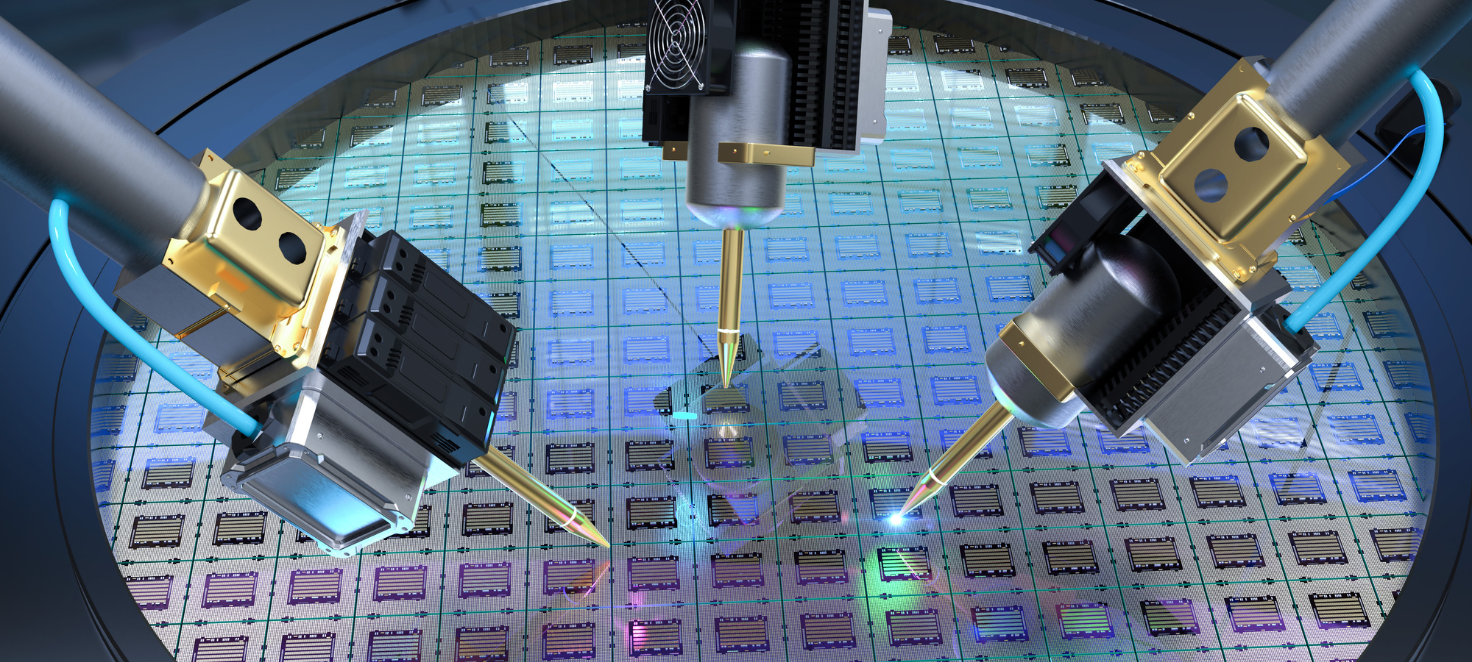
Edge AI chips directly address these constraints. Instead of universal compute units, they contain specialised hardware blocks designed to execute exactly the operations that dominate AI models. These blocks are often referred to as Tensor Processing Units or Neural Processing Units. The label itself is less important than the implication: the hardware is tightly optimised for a narrowly defined class of computations and can execute them with much lower energy consumption and predictable latency.
As a result, edge AI chips move the execution of AI models directly into the device. They do not handle model training, but rather execution during operation, inference. Perception, evaluation, and response move closer together in time. Decisions are made where data is generated, not at a distant location.
Shifting AI execution from the cloud into the device changes system behaviour on several levels. The first and most immediately measurable effect concerns latency. In classical architectures, the path between perception and action includes data transmission, external processing, and return communication. Even in well-provisioned networks, this delay fluctuates with load, routing, and prioritisation. For physical systems, the average latency is less problematic than its unpredictability. Edge AI removes this variability by keeping decisions local. Perception and response occur in close temporal proximity and follow a stable, deterministic pattern.
Closely linked to this is energy consumption. Running AI workloads on universal processors or in remote cloud infrastructures carries a high energy cost, either locally due to inefficiency or centrally due to large-scale infrastructure requirements. Edge AI chips, by contrast, are optimised for a specific computation profile. They execute only the operations required for inference and forego general flexibility. This significantly reduces the energy required per decision. For mobile robots, autonomous vehicles, or battery-powered systems, this is not an optimisation but a prerequisite for operation.
Another consideration is robustness in the face of infrastructure constraints. Systems that depend on external compute resources for every decision behave erratically when connectivity is limited and may fall back into degraded modes. Local AI execution decouples decision-making from network availability. The system remains operational even when connections are disrupted or deliberately constrained. Central systems continue to play a role in tasks such as model training, fleet coordination, and analysis, but they are no longer part of every reaction loop.
This shift also affects scalability. When each device makes its own decisions, overall load no longer grows linearly on a central instance as the number of systems increases. Compute demand is distributed across many local units. This simplifies the sizing of central infrastructure and reduces bottlenecks. At the same time, individual system behaviour becomes easier to isolate. Errors or delays remain local rather than propagating across the entire system.
Finally, system transparency improves. Local decision logic can be clearly attributed to a specific device and situation. Decisions occur where they can be observed and are easier to analyse and test. In safety-critical or regulated environments, this traceability matters because technical responsibility can be clearly assigned.
How strongly this architectural shift is already reflected in real systems can also be shown quantitatively. The following figures place these changes in context using publicly available market and technology data from several independent studies. The data has been normalised across common categories and time horizons, and consolidated where different segmentations were used, to make multi-year developments comparable.

The values for 2024, 2025, and 2034 are based on market estimates and forecasts; intermediate years are derived from the stated compound annual growth rate to illustrate the trajectory. Currency conversion from USD to CHF uses ECB reference rates. The chart provides a straightforward indication of how rapidly edge AI hardware is moving toward broad adoption over the coming decade.

This chart shows how the use of edge AI chips evolves across application domains. Growth is particularly pronounced in industrial automation, surveillance, and mobility, while healthcare and agriculture gain momentum later but steadily. The data illustrates that edge AI is expanding into a wide range of physical processes rather than remaining confined to a single sector.

This chart highlights the shift from general-purpose processors toward specialised AI hardware in edge environments. While CPU- and GPU-based solutions gradually lose share, ASICs and integrated NPUs gain ground. This reinforces the broader trend toward energy-efficient, deterministic inference close to the physical process.
The following examples illustrate how these developments are realised in concrete system architectures.

Autonomous mobile robots (AMRs) move through complex environments such as factory floors, detect obstacles, and continuously adjust their routes. Edge AI allows perception to be processed directly on the device, significantly improving response time and reliability. By reducing reliance on central cloud evaluation, robots can interpret environmental signals immediately. Industry and research alike see this as a critical enabler for autonomous navigation without constant cloud dependency.
Knowledge, Links & Sources:

In assembly and service environments, humans and robots work in close proximity. Edge AI enables robots to analyse forces, positions, and movements in real time and respond appropriately. Research demonstrates how visual perception, motion modelling, and semantic interpretation can be implemented locally, without relying on remote servers. This capability is essential for achieving safe and responsive collaboration between people and machines.
Knowledge, Links & Sources:

In security-critical environments such as warehouses or building complexes, edge AI enables video analytics to run directly on site. AI models operate locally on end devices to detect people, vehicles, or behavioural patterns in real time, without first sending data to the cloud. Practical deployments show how local video analytics can improve decision speed while reducing the load on central systems.
Knowledge, Links & Sources:

In industrial facilities, sensors continuously capture condition data such as vibration, temperature, current draw, or pressure. These signals provide insight into the wear and health of machines and components. When evaluated centrally, delays and dependencies on network capacity arise. Edge AI enables analysis directly at or near the machine. Models detect deviations from normal operation early and trigger maintenance actions before failures occur, enabling condition-based maintenance rather than fixed schedules.
Knowledge, Links & Sources:

Modern agriculture increasingly relies on drones, ground-level sensors, and mobile machinery to monitor fields and crop conditions. Camera systems detect weeds, pests, or growth variations, while sensors measure soil moisture and nutrient levels. Edge AI allows this data to be analysed directly in the field or on the device. Decisions such as targeted irrigation, fertilisation, or treatment can be made immediately, without transferring large data volumes to central systems. In large or remote farming areas with limited connectivity, this local intelligence enables more precise and resource-efficient operations.
Knowledge, Links & Sources:
At ITConsulting24 AG, we support organisations in Switzerland in the planning, implementation, and ongoing evolution of complex IT, software, and digital transformation initiatives. In the context of edge AI, robotics, and autonomous systems, we do not position ourselves as a platform provider, but as a consulting partner working alongside clients to examine technical options, system architectures, and operational implications. The emphasis lies on realistic use cases, clearly defined levels of autonomy, integration with existing IT landscapes, and early consideration of operational, security, and responsibility-related aspects.
The next article in AI & Robotics will explore how local AI inference interacts with decision-making and control logic, and what this implies for system architecture, operations, and governance. Rather than focusing on individual technologies, the discussion will centre on how systems, processes, and responsibilities come together in real-world operation.