
Autonomous construction robots are no longer a distant vision where a lone robot performs a spectacular task on a construction site. Their true potential emerges when they become part of a continuously adaptive infrastructure: a site that constantly monitors its state, detects deviations early, deploys machinery more effectively, and gradually removes humans from particularly hazardous, repetitive, or ergonomically challenging tasks. This discussion ties into the Beta-Agenda theme „Infrastructure as a Living System“ and the focus on „Autonomous Construction Robots,“ positioning these robots as components of safer and faster construction sites. The practical value lies not in the notion of a fully automated site but in a straightforward question: Which construction processes today are so repetitive, data-rich, safety-critical, or time-sensitive that robotics can already provide substantial value?
Autonomous Construction Robot: An autonomous construction robot is a mobile or stationary machine that independently or semi-independently performs a clearly defined construction task using sensors, control software, and decision logic. It doesn’t replace the entire site but takes on limited tasks such as surveying, marking, earthmoving, material transport, inspection, reinforcement work, or solar field assembly. Continuously Adaptive Infrastructure: This refers to a construction and operational environment that is not merely planned and then executed, but continuously compares its actual state with the plan and derives operational adjustments. Digital Construction Model: A digital construction model describes the geometry, components, trades, and sometimes even schedule or quality information of a construction project in a machine-readable format. It is crucial for robots because machines don’t work with intentions but with precise coordinates, tolerances, and permissible work areas. Digital Twin: A digital twin is a continuously updated digital representation of a real construction or site. Its value arises when it not only provides attractive visualizations but also makes deviations, risks, and progress visible, enabling better decision-making by site management, planning, and execution. Sensor Fusion: Sensor fusion means combining multiple data sources such as cameras, laser scanning, position data, radar signals, inclination sensors, or machine data. A robot needs this combination because a construction site is dusty, uneven, cramped, variable, and often poorly documented. Edge AI: Edge AI refers to AI models that operate directly on the machine or close to the site, rather than sending every decision to a remote cloud. This is relevant because construction sites do not always have stable networks, and safety-critical decisions cannot depend on latency or connection failures. Functional Safety: Functional safety ensures that a machine reacts in a controlled and predictable manner in the event of errors, unsafe conditions, or limit violations. For autonomous machines, a classic emergency stop alone is insufficient, as paths, software updates, remote access, and AI-driven decisions are also part of the risk profile. Geofencing: Geofencing refers to digital boundaries within which a machine may or may not move. On construction sites, this can involve work areas, restricted zones, crane areas, fall edges, traffic routes, or interaction zones with people. Human-Robot Teaming: Human-robot teaming describes the organized collaboration between professionals and robots. In practice, this is often more important than full autonomy because humans continue to handle context, prioritization, exception handling, and responsibility, while robots stabilize repetitive or dangerous sub-tasks.
The construction industry presents more challenges for robotics than a factory setting. In a factory, paths, lighting, machine positions, components, and processes are often stable for years. On a construction site, however, surfaces, access points, weather conditions, material storage, trades, safety zones, and priorities can change daily. This is precisely why earlier robotics projects in construction often disappointed: They were treated like demonstration devices, not as productive construction machines with clear tasks, integration, accountability, and economic goals. Developments in 2026 indicate a more mature phase. Current market analyses foresee recurring productive applications mainly in limited workflows such as layout, earthworks, reinforcement, digital capture, and solar infrastructure; the strongest applications are not the broadest but those that reliably and frequently perform a narrowly defined task.
The central shift is that construction robots are no longer merely seen as mechanical aids. They become data interfaces between planning, execution, and operation. A layout robot transfers digital plan data directly to the ground. An inspection robot documents construction progress at night and detects deviations. An autonomous compaction or earthmoving system not only performs material movements but also generates position, quality, and progress data. A robotic system for solar fields integrates assembly, quality assurance, and logistics into a more controlled process. This creates a feedback loop that is often missing in traditional construction workflows: The actual state of the site flows back more quickly into planning, scheduling, procurement, quality assurance, and safety management.
For developers and decision-makers, the first question is not which robot looks the most impressive. The better question is where a process is sufficiently digitally prepared, repeatable, safety-relevant, and economically viable. A robot that is rarely used on a small, constantly improvised site is more likely to create effort than value. The same robot can make a clear contribution on a large interior fit-out, an infrastructure corridor, a serial housing platform, a bridge, a data center, or a solar field because the areas, cycles, and tolerances are large enough. Economic viability arises from utilization, not ownership. Those who procure robotics as an innovation object underestimate training, data preparation, site logistics, safety concepts, and process integration. Those who introduce robotics as productive construction equipment define deployment windows, handover points, responsibilities, abandonment criteria, and metrics.
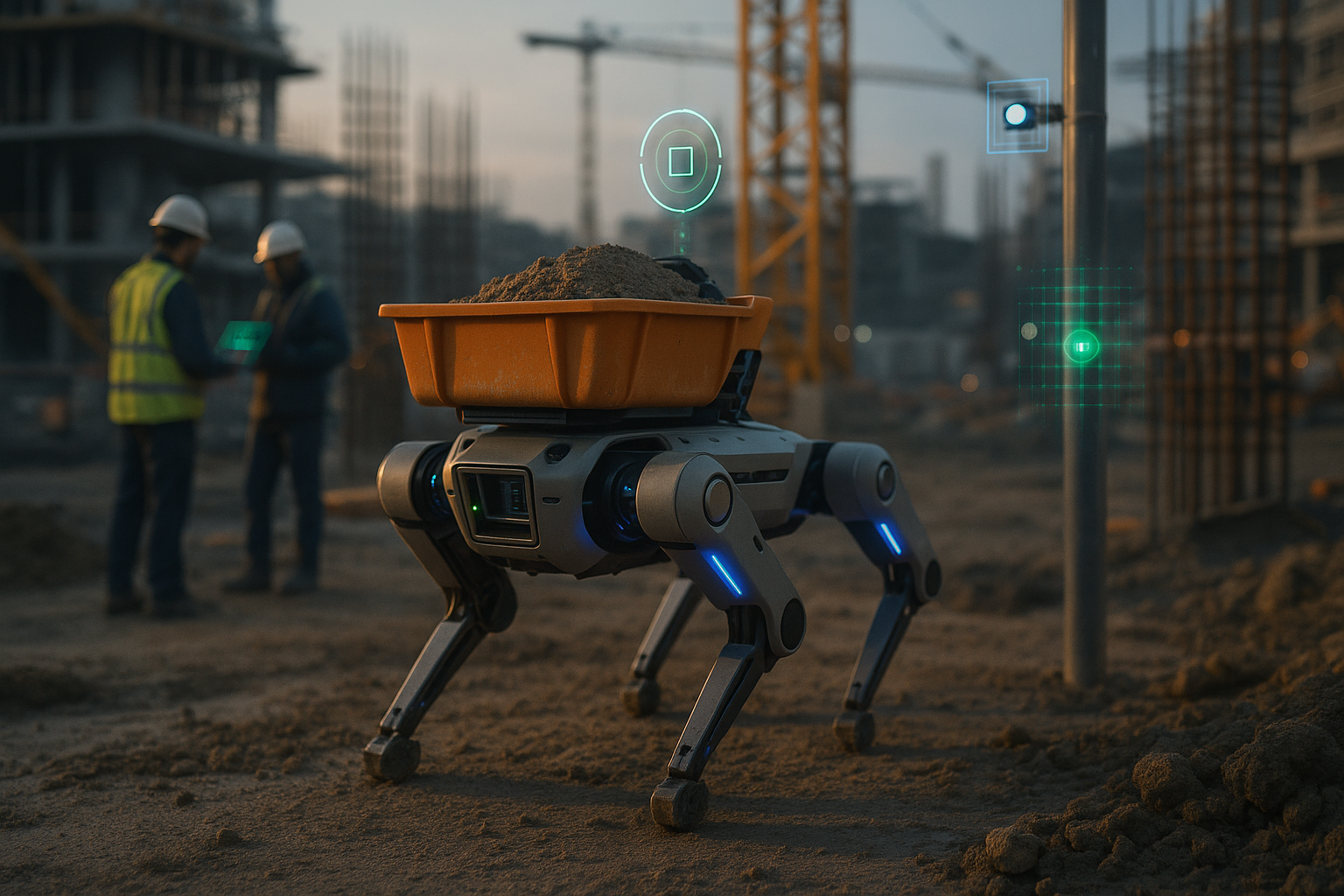
Safety is both the most important and most frequently misunderstood benefit. A construction robot does not automatically make a site safe. However, it can remove people from areas dominated by vibration, noise, dust, heat, fall risk, heavy loads, monotonous repetition, or machine traffic. A remotely controlled or autonomous excavator can work in dangerous terrain while the operator remains outside the cabin. A four-legged inspection robot can collect data at night or in hard-to-reach areas without a professional having to walk alone through unfinished floors. A robotic solar mounting system can move heavy glass and steel in a controlled manner instead of distributing lifting work manually over long shifts. Bauma describes efficiency, safety, and skill shortages as essential drivers of autonomous construction machinery and cites dangerous sites such as unstable ground as suitable application fields for remote control and semi-autonomous machines.
Simultaneously, new risks arise. Once a machine drives itself, collects data, works with construction models, can be remotely controlled, or receives software updates, the attack surface expands. Previously, safety often consisted of mechanical safeguards, visual contact, instruction, and emergency stops. Today, identities, access rights, network segments, remote maintenance, update approvals, sensor data quality, logging, and model versions are added. An incorrectly imported coordinate system can make a layout robot seem harmless while leading multiple trades in the wrong direction. A compromised remote access to a mobile machine is not just an IT problem but a physical safety issue. An AI system that misjudges obstacles in dust, backlight, or wet surfaces cannot be secured with a general data protection policy. Therefore, functional safety, operational site safety, and cybersecurity must be considered together. The upcoming European Machinery Regulation explicitly addresses artificial intelligence, autonomy, and networking more strongly and applies to the placing of machines on the market from January 20, 2027. TÜV NORD also highlights new requirements for protection against external attacks as well as for autonomous systems and AI systems.
The technical architecture of successful construction robotics usually follows a similar pattern. First, a sufficiently precise digital model or a clearly defined task is needed. Then, reliable localization is required so the machine knows where it is in relation to the plan, people, obstacles, and restricted zones. Next, an execution logic is needed that not only knows an ideal sequence but can handle deviations. The real value, however, arises in the feedback: What has the machine done, where were there deviations, what tolerances were reached, which areas could not be processed, what dangers were detected, and what decision must a human now make? Without this feedback, robotics remains isolated automation. With this feedback, it becomes part of a learning operational model.
A vivid example is earthmoving. In January 2026, Caterpillar announced autonomous product lines for excavators, loaders, dump trucks, dozers, compactors, and site optimization. The systems aim to combine sensors, real-time data, autonomous navigation, and fleet coordination; Caterpillar describes the underlying architecture with AI, machine learning, computer vision, edge computing, LiDAR, radar, GPS, and high-resolution cameras. The key is not just that a machine operates without constant manual control. The key is that multiple machines can be coordinated within a controlled work area. For large construction sites, this means less idle time, more consistent work quality, better traceability, and potentially less pedestrian traffic in the immediate machine environment.
In layout and surveying, the benefit is different. The robot does not move tons of material but translates digital intent into physical reality. When walls, door openings, penetrations, conduit paths, or mounting points are directly transferred from the coordinated digital model to the ground, a typical source of error is reduced: the manual translation from plan to site. The benefit is particularly high when downstream trades are closely coordinated, such as in hospitals, data centers, laboratories, hotels, or serial housing. An incorrectly placed penetration or marked axis not only causes rework but also schedule delays across multiple trades. Therefore, robotic layout is less a surveying gimmick and more a method to make planning quality visible earlier.
Inspection and capture robots clearly demonstrate the concept of continuously adaptive infrastructure. In March 2026, Boston Dynamics and FieldAI announced a partnership for autonomous robotics in dynamic construction site environments. The rationale is noteworthy: Construction sites are constantly changing, traditional programming quickly reaches its limits in such environments, and the ongoing capture of precise information is labor-intensive and can expose workers to hazards. FieldAI describes that robots equipped with cameras, LiDAR, and onboard sensors can perform inspection, mapping, and monitoring tasks without prior maps, GPS, cloud connection, or predefined routes; the data flows back into existing digital construction models and digital twins. This is precisely the step from a one-time site tour to a continuous status picture.
Nevertheless, boundaries must be clearly defined. Autonomous construction robots are not adept at compensating for unclear responsibilities, poor plan data, contradictory construction processes, or lack of site management. A robot reinforces the quality of the system it is embedded in. Good geometry, clear work approvals, robust data states, maintained restricted zones, and clear escalation paths assist it. Unclear models, shifting improvisation, lack of network segmentation, untrained teams, and ambiguous liability make it expensive and risky. Especially SMEs should not start with the question of how quickly an entire site can become autonomous. The better entry point is a limited process with a high degree of repetition, a well-measurable outcome, and manageable integration effort.
For operation, a playbook is more important than a brochure. It should specify which data version is binding for the robot, who authorizes deployment, how restricted zones are maintained, what happens in case of a connection loss, who can abort a mission, how log data is secured, how a software update is tested, and which deviation automatically goes back to site management or planning. Such a playbook is not bureaucracy but the prerequisite for making robotics repeatable. Construction sites are already heavily dependent on experience. Robotics shifts part of this experience into explicit rules, digital approvals, and traceable states. This is culturally more challenging for many companies than the machine itself.
The role of employees also changes. Good construction robotics does not devalue expertise but makes it usable in different ways. Foremen, machine operators, surveyors, safety officers, and project managers become more like individuals who prepare workspaces, monitor machines, assess exceptions, and derive decisions from data. The productive robot needs experienced people because, while it can perform repeatable tasks very well, it does not automatically understand why a trade is prioritized today, why an access route is blocked despite the plan, or why a seemingly small deviation can have major consequences later. The mature target state is therefore human-robot teaming, not a human-free construction site.
Economically, the best effects occur where three factors converge. First, the task must occur frequently enough so that setup, training, and process adjustments are not paid for anew each time. Second, the task must be on the critical path or cause high rework costs so that quality and time gains truly matter. Third, the robot results must be fed back into existing systems so that not only execution but also control improves. Without this third point, the benefit remains local. With it, an infrastructure emerges that makes itself more readable.
Example one: Autonomous Earthmoving on a Large Infrastructure Site
A medium-sized construction company undertakes the site preparation for a new logistics and data center area. The site is expansive, the mass movements are significant, and trucks, dozers, excavators, and surveying teams operate in parallel. Instead of viewing autonomy as a full replacement for machine operators, a limited work area is defined where autonomous or semi-autonomous machines execute grading, material movement, and compaction according to an approved digital terrain model. The operators remain responsible but work more as supervisors, approvers, and exception decision-makers. The benefit is not only in speed but primarily in consistent quality, fewer people in the direct danger zone, and better traceability of the work performed. It is critical that access routes, restricted zones, machine rights, emergency processes, and data versions are well-managed, as an autonomous dozer is only as good as the digital workspace it operates in. This scenario is realistic because manufacturers and market reports in 2026 describe precisely this development: autonomous machines are introduced not as construction magic but in narrowly defined, machine-intensive workflows with clear oversight and measurable outcomes.
References:
Example two: Nightly Site Capture in Shell Construction
A general contractor is building a hospital with tight tolerances, numerous technical installations, and high coordination effort between finishing, building services, and medical technology. During the day, a full manual capture would be disruptive, slow, and partly risky because many trades are working simultaneously. Therefore, a mobile inspection robot is used for nightly rounds, capturing site condition, hazard areas, progress, and deviations, and replaying the data into the digital construction model the next morning. The site management sees not just photos but structured hints: an open edge, blocked escape routes, missing markings, deviations from planned installation zones, or areas inaccessible due to material storage. The robot does not decide whether a trade is rescheduled; it makes the state visible earlier so that humans can decide faster. The productive effect arises from repetition: Every morning, a comparable site status is available, turning documentation into a control instrument. Especially in complex interior constructions, this approach can reduce rework because deviations are not only recognized when several trades have already built on them.
References:
Example three: Robotic Solar Infrastructure as a Construction Process with Feedback Loop
An energy provider plans a large solar field that needs to go online quickly due to tightly scheduled grid connection, financing, and power purchase agreements. Traditionally, the site would be heavily reliant on manual assembly: setting foundations, aligning supports, moving heavy modules, quality control, and documenting progress over many hectares. In a robotically supported approach, piles are first set more precisely with autonomous or robotically stabilized systems, then module and support units are pre-assembled, inspected, and brought to installation points in a mobile, field-proximate process. Humans do not disappear from the process, but they are partially removed from monotonous lifting work, extreme environmental conditions, and vibration-intensive steps. The actual infrastructure gain lies in the convergence of construction speed, quality assurance, and progress data: Every set structure and mounted unit generates data that can improve financing, grid connection planning, operational preparation, and future maintenance. Such systems demonstrate why autonomous construction robots gain particular importance where infrastructure itself becomes a bottleneck, such as in energy, data centers, transport corridors, or industrial expansions.
References:
How ITConsulting24 AG Can Assist
ITConsulting24 AG can support companies in this area where robotics, data platforms, cloud operations, and security converge. The company operates a modern private cloud environment with AI capabilities and has practical experience with digital platforms and models, including operation, training, and fine-tuning. This experience is relevant for construction robotics because the value does not arise solely from the machine but from data flows, integrations, safety zones, access rights, operational models, and traceable decision paths. ITConsulting24 AG can help companies build understandable playbooks, governance structures, and security concepts to make digital environments more transparent, risks more visible earlier, and actionable next steps definable. The focus is not on exaggerated autonomy promises but on a controlled build-up: identifying suitable processes, checking data quality, clarifying safety and operational requirements, making pilot goals measurable, and then deciding whether scaling is economically and organizationally sensible.
Outlook
The logical next topic is the secure integration of humans, robots, and digital operational models on real construction sites. It will focus less on individual machines and more on responsibilities, approvals, safety proofs, training, cybersecurity, data quality, and how construction companies reliably lead mixed teams of professionals, machines, and AI systems. In a continuous series, this topic can be systematically deepened, from the first robotics playbook to functional safety to governance for networked construction sites. Feedback from real projects is particularly valuable because robust construction robotics is not decided in the lab but where schedules, weather, safety, budget, and people come together every day.

The data shows the projected growth of the autonomous construction robot market from 2024 to 2030. The market is expected to grow from USD 1.12 billion in 2024 to USD 2.76 billion in 2030, representing a compound annual growth rate (CAGR) of 14.2%. This development underscores the increasing significance and impact of autonomous technologies in the construction industry. The forecasts are based on current market analyses, although unforeseen economic or technological changes could influence the actual development.
Source: Strategic Market Research, Construction Robot Market, 2024
The examples illustrate how autonomous construction robots are deployed in various scenarios to enhance efficiency, safety, and data integration. They highlight the practical application and added value of robotics in the construction industry.

A leading construction company employs autonomous earthmoving machines for the preparation of a logistics center. These machines use sensors and AI for precise material movements and compaction, resulting in consistent work quality and reduced safety risks. The deployment of autonomous systems enables more efficient coordination of multiple machines and reduces the need for direct human interaction in hazardous areas.
Sources & further reading

A general contractor uses mobile inspection robots for nightly capture of construction progress in a hospital building. These robots document the site condition and identify potential hazard areas, providing site management with structured data the following morning. This enables faster decision-making and reduces rework through early detection of deviations.
Sources & further reading

An energy provider implements robotic systems for constructing a large solar field. These systems handle the precise placement of piles and the assembly of solar modules, improving construction speed and quality assurance. The integration of progress data into existing systems optimizes the planning and operation of the solar field.
Sources & further reading
With the increasing integration of autonomous construction robots into the construction industry, companies face the challenge of seamlessly integrating these technologies into their existing processes. ITConsulting24 AG offers the necessary support to successfully navigate this transformation. Our expertise in system architecture and digitalization enables us to guide you in implementing robotics solutions that are not only efficient but also safe. We assist you in identifying the right processes and ensuring data quality to ensure your construction sites become adaptive infrastructures. We place particular emphasis on developing playbooks and security concepts that make the deployment of robots on construction sites transparent and traceable.
In the next article of our series in the Robotics channel, we will shift to the overarching topic of Human + Machine Integration. There, we will explore the theme of Enhancing Human Capabilities. The focus will be on how cyborg technologies and the integration of human and machine can extend human abilities.