
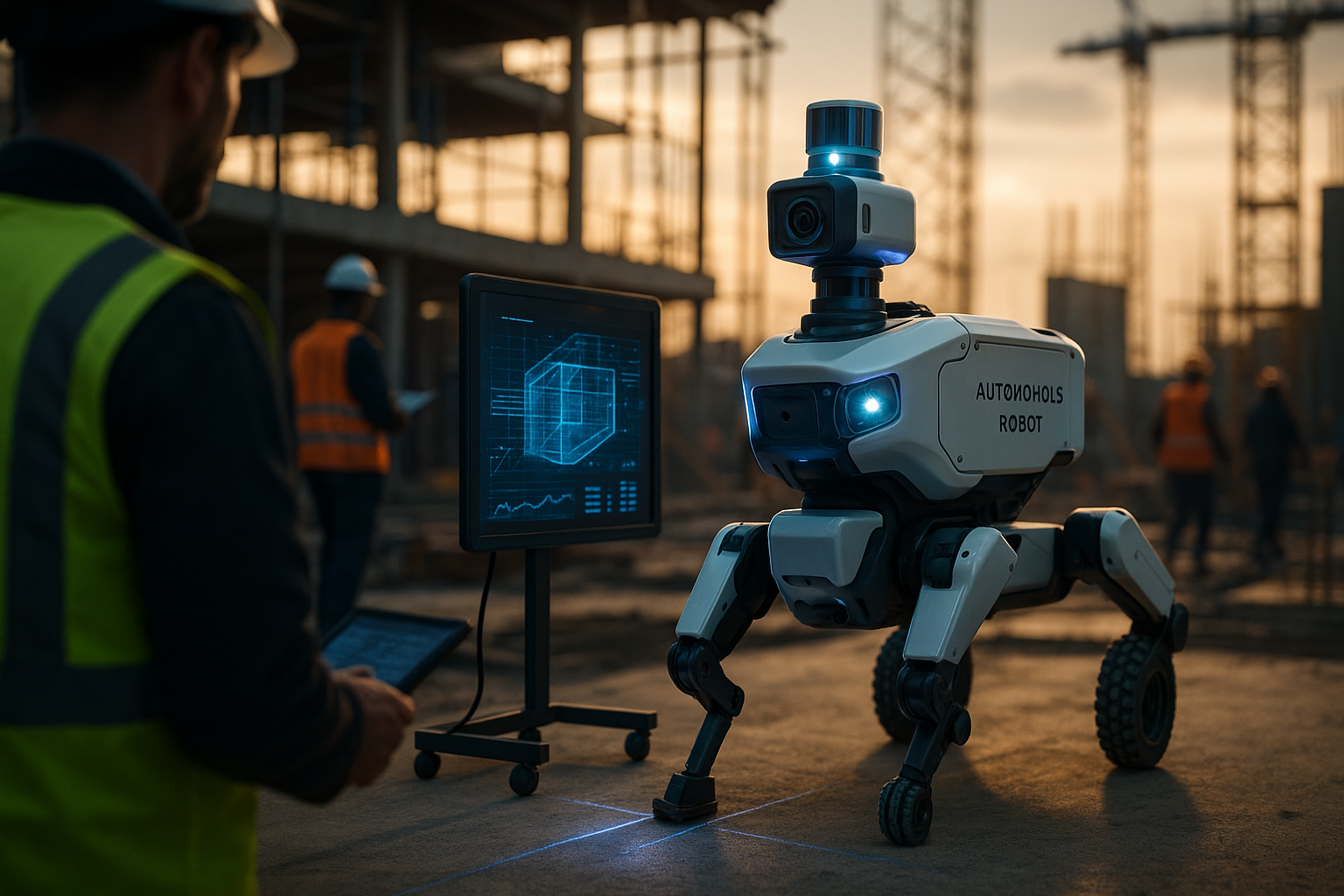
Autonomous construction robots are not merely machines that automate specific tasks with flair. Their true value emerges when they become integral to a continuously learning construction infrastructure: they monitor conditions, compare plans with reality, execute repetitive tasks with precision, and relieve humans from dangerous, heavy, or monotonous work. For construction firms, infrastructure operators, and technical decision-makers, the pertinent question is not whether a site will soon operate entirely autonomously. More crucial is identifying which processes are already repeatable, data-rich, and safety-critical, where robotics can demonstrably enhance operations.
Autonomous Construction Robot: An autonomous construction robot is a mobile or stationary machine that independently or semi-independently performs a clearly defined construction task using sensors, software, and decision-making logic. It does not replace the entire site but takes on jobs such as surveying, marking, earthmoving, material transport, inspection, or assembly. Continuously Adaptable Infrastructure: This refers to a construction site that continuously monitors its real state and derives operational adjustments from it. Digital Building Model: This model describes geometry, components, tolerances, and work areas with such precision that machines can derive specific actions from it. Digital Twin: A digital twin is a continuously updated digital representation of the construction site or building, making deviations, progress, and risks visible. Sensor Fusion: Sensor fusion combines data from cameras, laser scanners, positioning systems, radar, or machine sensors to enable a robot to understand its environment more reliably. Edge AI: Edge AI means that AI models operate directly on or near the machine, allowing for swift and controlled decision-making even with weak connectivity. Functional Safety: Functional safety ensures that a machine responds predictably to errors, unsafe conditions, or limit violations. Human-Robot Teaming: This refers to the organized collaboration between professionals and robots, where humans retain context, responsibility, and decision-making in exceptional cases, while robots stabilize repetitive tasks.
The construction industry presents significantly more challenges for robotics than a factory environment. In a production hall, pathways, lighting, machine positions, and processes are typically stable. On a construction site, ground conditions, access points, material storage, weather, trades (the individual construction disciplines such as electrical, plumbing, or shell construction), safety zones, and priorities are constantly changing. Therefore, construction robots are only truly effective when their tasks are clearly defined. A robot seldom used on an improvised small site can quickly become more trouble than it’s worth. However, the same robot can add substantial value on large interior projects, bridges, data centers, infrastructure corridors, or solar fields, where the areas, sequences, and repetitions are sufficiently large.
The most significant shift is viewing construction robots not merely as mechanical aids but as data interfaces between planning, execution, and operation. A layout robot transfers digital plan data directly onto the ground. An inspection robot documents construction progress and detects deviations. An autonomous earthmoving system moves materials while simultaneously generating position, quality, and progress data. This creates a feedback loop often missing in traditional construction workflows: the real state is more rapidly fed back into site management, planning, quality assurance, and safety management.
Safety is a central benefit but not an automatic one. A construction robot does not inherently make a site safe. However, it can remove humans from areas dominated by noise, dust, vibration, heavy loads, fall risks, or machine traffic. An autonomous or remotely operated excavator can work in hazardous terrain while the operator remains outside the immediate danger zone. An inspection robot can collect data at night or in hard-to-access areas, eliminating the need for a professional to navigate unfinished building sections alone. A robotic assembly system – for example, an automated lifting or gripping arm for component assembly – can move heavy components more evenly, reducing physical strain.
Simultaneously, new risks arise. Once machines drive themselves, process plan data, are remotely controlled, or receive software updates, the attack surface expands. In the past, safety primarily involved visual contact, safety training for staff, barriers, and emergency stops. Today, it includes identities, access rights, network segments, remote maintenance, update approvals, sensor data quality, and model versions. An incorrectly imported coordinate system can result in a layout robot marking correctly but in the wrong location. Compromised remote access to a mobile machine is not just an IT issue but a physical safety concern. Thus, site management, IT security officers, and robot providers must plan site safety, functional safety, and cybersecurity together from the outset.
The technical architecture of successful construction robotics usually follows a straightforward pattern. First, a precise digital model or a clearly defined task is needed. Then, reliable localization is required so the machine knows its position relative to plans, people, obstacles, and restricted zones. Next, an execution logic is necessary that not only knows the ideal scenario but can also handle deviations. The real value, however, emerges in the feedback: what was executed, what tolerances were met, which areas were blocked, what hazards were detected, and where must a human decide?
Earthmoving serves as a good example. Autonomous excavators, dozers, loaders, or compactors (rollers or plate compactors that compact soil or pavement) are interesting not because they operate without visible human intervention. The key is that they can coordinate multiple steps in a controlled work area, work more consistently, and provide data on progress and quality. For large construction sites, this means less downtime, better traceability, and potentially less pedestrian traffic in the immediate machine environment. In layout and surveying, the benefit is different: the robot does not move tons of material but brings digital planning precisely into the physical site. Especially in hospitals, data centers, laboratories, or serial residential buildings, this can reduce rework, as incorrectly marked axes, openings, or assembly points often affect multiple trades at once.
Inspection and data collection robots particularly illustrate why construction sites increasingly function like learning systems. They not only document what is visible but also make changes comparable. When the same area is captured every night, a continuous state image emerges. Site management can detect earlier if materials are misplaced, safety zones are blocked, installations deviate from the model, or certain areas were inaccessible. The robot does not decide the construction sequence. It makes the state visible more quickly so that humans can make better decisions.
Boundaries remain important. Autonomous construction robots make up for neither poor planning, unclear responsibilities, nor contradictory processes. They enhance the quality of the system they are embedded in. Good models, clear approvals, well-maintained restricted zones, trained teams, and clear escalation paths support them. Unclear data states, constant improvisation, lack of network segmentation (the division of a network into separate, secured zones), and unclear liability make them expensive and risky. SMEs in particular should not start with the vision of a fully autonomous site, but with a limited process that occurs frequently, is measurable, and incurs high rework or safety costs.
For operations, a playbook is more important than a prospectus. It should specify which data version is binding, who authorizes robot deployment, how restricted zones are maintained, what happens in case of connection loss, who can abort a mission, how log data is secured, and how deviations are reported back to site management or planning. This way, robotics becomes not an exception but a repeatable operational process.
Well-implemented construction robotics does not devalue expertise but makes it usable in new ways. Foremen, machine operators, surveyors, safety officers, and project managers remain central because they carry context, priorities, and responsibility. The robot stabilizes repetitive tasks, but it does not automatically understand why a trade is prioritized, why an access road is blocked today, or why a small deviation can have significant consequences later. The realistic goal is not a human-free construction site but one where humans and machines collaborate more clearly, safely, and data-driven.
Economically, the best effects occur where three conditions converge: the task occurs frequently enough, it significantly impacts safety, quality, or timelines, and the results feed back into existing systems. Without this feedback, robotics remains local automation. With it, it becomes part of an infrastructure that makes itself more comprehensible, thereby operating faster, safer, and more controlled.
—

The data shows the number of fatal workplace accidents in the U.S. construction industry from 2019 to 2024. In 2024, the number fell to 1,034 deaths – a 3.8% decrease from 1,075 the year before, at a rate of 9.2 fatal injuries per 100,000 full-time-equivalent workers. The trend shows a slight improvement, yet construction remains one of the most dangerous industries: roughly one in five fatal workplace accidents in the U.S. occurs on a construction site. The adoption of autonomous construction machinery can help remove people from the most hazardous situations. The data is limited to the U.S. construction sector and does not account for other countries or industries.
Source: U.S. Bureau of Labor Statistics, Census of Fatal Occupational Injuries (CFOI), 2019–2024 (2024 figures published February 2026)
—

The chart highlights two well-documented figures from earthmoving: for pile installation on solar farms – one of the largest use cases for autonomous earthmoving – autonomy kits for excavators increase installation rates by 25–40% and cut rework rates by around 86% (down to below 0.5%, compared to 3–4% for manual work). Comparable jumps show up in other workflows too: layout robots like the Dusty FieldPrinter cover 40,000–70,000 sq ft per shift, versus 8,000–15,000 for a manual survey crew. Rebar-tying robots like TyBot tie over 1,100 intersections per hour, compared to 150–250 for an experienced tradesperson. These figures come from documented, repeat deployments, not model estimates.
Source: Zacua Ventures, Hilti Ventures & 94 Ventures, „Construction Robotics Report 2026“
—

Construction-specific figures are now available on the economics side too. A layout robot shortens the schedule on a 500,000 sq ft project by 7–10 days, which translates into direct savings of $25,000–50,000 – against a subscription cost of $8,000–12,000 per month, meaning a single schedule compression like this alone covers roughly 2.5–5 months of the subscription. Digital capture robots typically pay for themselves in under six months, because they reduce claims risk by $80,000–150,000 per project, at a cost of just $3,500–5,500 per month. These figures come directly from construction – the earlier metric was based on a warehouse logistics study and wasn’t directly transferable.
Source: Zacua Ventures, Hilti Ventures & 94 Ventures, „Construction Robotics Report 2026“; Bricks & Bytes, „Construction Robotics in 2026“
—
The examples demonstrate the practical application of construction robotics in large infrastructure projects, underscoring their benefits in terms of efficiency and safety.
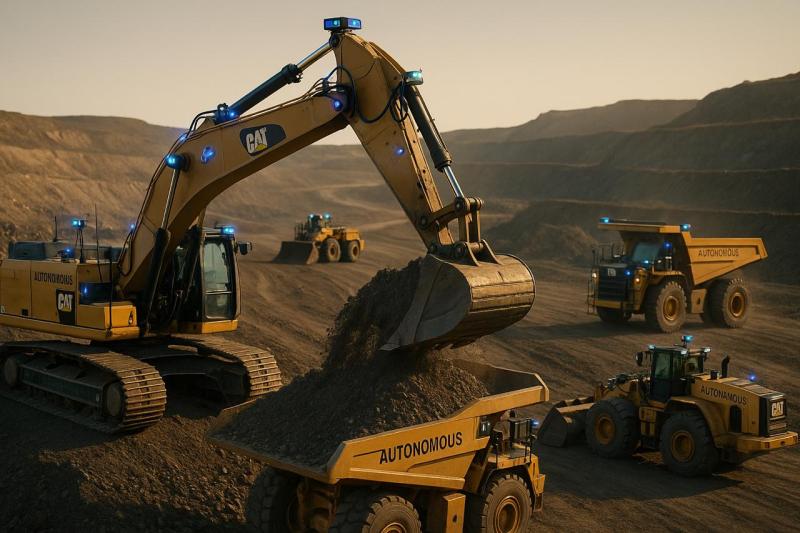
In 2026, Caterpillar introduced autonomous equipment lines for excavators, loaders, and other machines developed specifically for use in the mining industry. These machines use technologies such as computer vision, LiDAR, and GPS to work in a coordinated way within a controlled area. Deploying these autonomous machines has reduced idle time and increased safety, since fewer people now need to work near moving steel.
Sources & further reading
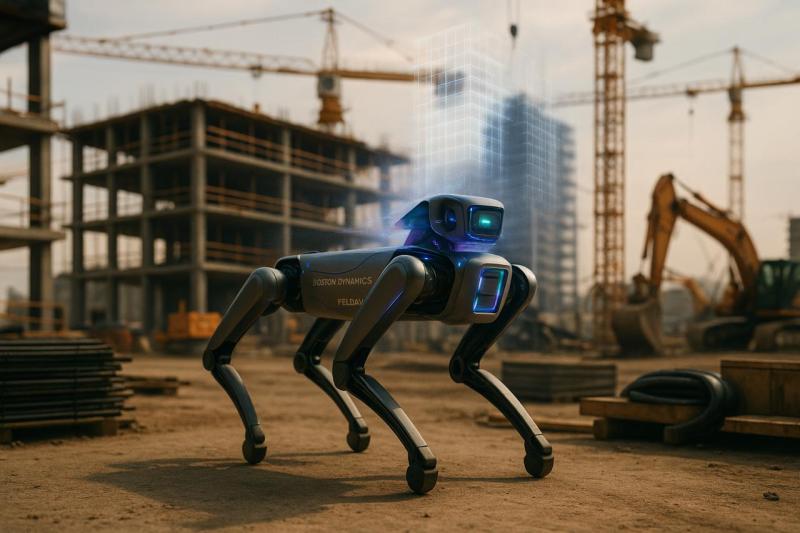
In March 2026, Boston Dynamics and FieldAI launched a partnership to develop autonomous inspection robots that can operate without a pre-existing map, GPS, or cloud data. These robots can adapt to the constantly changing conditions on construction sites and deliver real-time data that feeds back into the building model. This allows the site status to be continuously updated and improves real-time decision-making.
Sources & further reading
Both examples show impressively what is technically possible on large infrastructure projects. But they come from megaprojects with matching budgets – leaving open the question of whether construction robotics also pays off for small and mid-sized construction firms. Current market data now gives a clear answer.
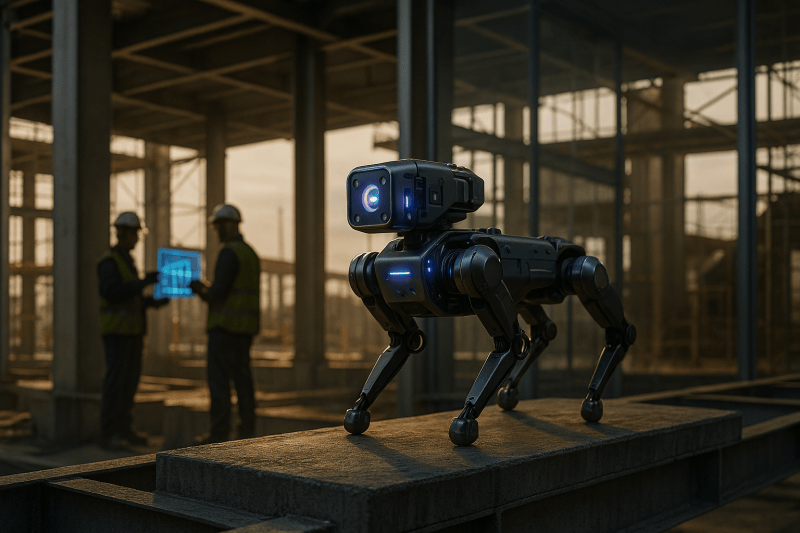
A growing share of construction robotics today isn’t sold as an expensive new purchase, but as a retrofit kit or subscription. Providers such as Gravis Robotics retrofit existing excavators with autonomy kits instead of selling new specialized machines – tested, among other places, in a pilot project at Manchester Airport. Layout and rebar-tying robots are increasingly offered on a subscription basis (Robotics-as-a-Service) rather than for purchase. This significantly lowers the barrier to entry for smaller firms: no major capital investment is required, just a clearly defined, recurring process in your own equipment fleet that’s worth retrofitting or subscribing for.
Sources & further reading
Autonomous construction robots offer exciting possibilities for boosting efficiency and safety on construction sites – and, as the current numbers show, increasingly for small and mid-sized construction firms too. The prerequisite is always that system architecture, functional safety, and cybersecurity are considered from the very start. That’s exactly where ITConsulting24 AG comes in: we connect you with experienced specialists in Robotics, Cyber Security, and Private AI Cloud, who support you in planning a secure system architecture, securing remote access and networks, and integrating robotics into your existing IT landscape. That way, your construction site infrastructure stays not just automated, but continuously adaptable and secure.
In the next article in our Robotics series, we will shift to the broader topic of Responsible AI and Governance. We will explore how ethical guidelines and regulations influence the development of AI robotics in the context of safety and public trust.